
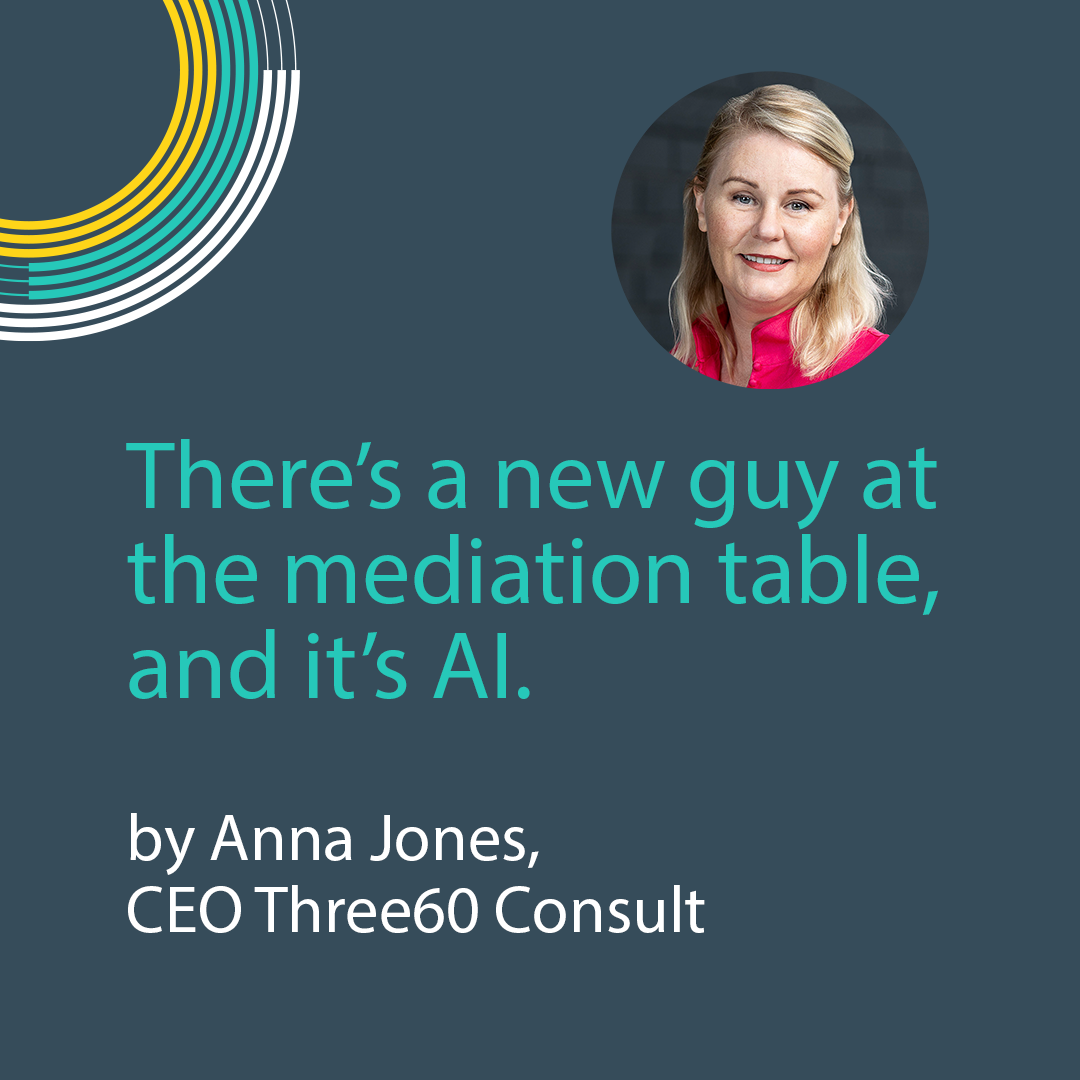
Anna Jones, CEO of Three60 Consult, has extensive experience in employment relations, mediation and workplace dispute resolution. Having supported the resolution of thousands of workplace disputes, Anna shares her perspective on how AI is changing mediation, and why skilled human judgement remains critical to achieving practical outcomes.
How AI is changing employment mediation and workplace dispute resolution in New Zealand
AI is already changing the way employment relationship problems are being framed and pursued in New Zealand.
Most of the discussion I’ve seen to date has focused on what AI might mean for the Employment Relations Authority or the courts with lengthy submissions that are often full of words but short on substance. However, the more immediate impact of AI is being felt earlier in the dispute resolution pathway before litigation, particularly through early resolution and mediation.
How AI is influencing employment mediation
Understandably, people are turning to AI to assess the strength and value of their own case. On one hand, this is to be celebrated as it can improve access to information for employees who can’t afford legal advice, or employers trying to get a quick sense of their position. On the other, larger, more gnarly hand, the advice AI spits out is only as good as the information it is given. And people being people, that information is usually skewed to support a narrative of being wronged.
Most people will be seeking validation as it’s hard to be objective when you’re in the thick of an employment dispute. Input may not include all relevant documents, the other party’s explanation, the legal context, the evidential problems, the credibility issues, and the questions asked of AI may not be the right ones.
The result is that AI can end up confirming the user’s view rather than testing it. A not insignificant number of people now arrive at discussions, negotiations or mediation with a very firm view of their prospects, the likely compensation, and what they are “owed”. In some cases, those expectations are well beyond what we see in reality and the caselaw provided by AI feels like another layer of validation, when often the cases relied on are not relevant or even real. The result of this is it’s much harder for mediators, lawyers and representatives to ground parties back to reality.
There is another issue too, where in essence, the robots are talking to other robots and people have handed over responsibility for the conflict. We are starting to see grievances written by AI, employer responses written by AI, and submissions drafted with heavy reliance on AI. The documents may sound polished, cite legal principles and even refer to cases. But sometimes the substance is thin, the tone is unnecessarily adversarial, and the humanity of the dispute is lost.
At their core, employment relationship problems are people problems. They involve people who feel hurt, dismissed, embarrassed, misunderstood, disrespected, or under pressure. If both the complaint and the response are generated through a tool that amplifies certainty and sharpens the argument, we risk making early resolution harder, not easier.
This matters because mediation and attempts at early resolution work best when people can reassess. They need to be able to hear risk, recognise uncertainty, and move from a fixed position to a workable resolution. If AI has already told them they have a strong case, a high-value claim, and clear moral vindication, that can be difficult to unwind.
So the question is not whether AI belongs in employment relations; it’s already here. The better question is how do we work with people who come to the table armed with AI-generated advice? So naturally, I asked AI what it thought and it gave me the following points:
Five practical starting points
- Ask what AI has been used for: Not in a defensive or dismissive way, but to understand what has shaped the person’s expectations.
- Separate information from advice: Help parties distinguish between a general legal summary and a proper assessment of their specific facts, evidence, risks, and likely outcomes.
- Test the inputs: Ask: what information was provided, what was left out, and what assumptions did the AI appear to make?
- Bring the humanity back in: Move beyond the drafted position. What happened? What was the impact? What does each party actually need to move on?
- Reality-test without humiliating: People may have relied heavily on AI because they needed help. The task is not to make them feel foolish. It is to help them make better decisions with better information.
Ironically, that’s not bad advice. My fallible but real human brain would add the following:
- Most people aren’t upfront about using AI (yet), so seeking to understand how someone reached the view they have helps to open the conversation.
- Spend time understanding what is important to the person, because it’s not usually about obtaining lottery figures, more often than not, it’s about being able to stand up for themselves and then being able to move forward.
- Ensure there is adequate time available to help a person step back down from excessively high expectations. If there is a difference of more than one years’ salary between the parties, then a half day mediation probably won’t do it. But that extra half day will probably still be quicker and more cost effective than a trip down litigation lane.
Key takeaways
- AI is increasingly influencing employment disputes before they reach the Employment Relations Authority or the courts.
- AI can improve access to information but may also reinforce unrealistic expectations.
- Employment mediation works best when people remain open to reassessing risk and uncertainty.
- Human judgement, empathy and practical problem-solving remain critical to successful dispute resolution.
- The challenge is not whether AI should be used, but how it can be used responsibly
This piece isn’t intended to be a beat-up on AI. Historically ignoring new technology and hoping it will go away hasn’t been a particularly successful approach. Used well, AI might help people prepare, understand process, and identify relevant issues. Used poorly, it may entrench positions, inflate expectations, and remove the very human judgment that early resolution depends on.
And of course, it’s not just parties using AI. Increasingly, it’s the lawyers and representatives too… so I ask you, what does this mean for the future of dispute resolution?